The Hero of Hawaii
At the southern end of highway 137 on Big Island the road abruptly ends where Kilauea wiped out the southern part of the island in the ’80s. The remains of Kaimu now lie under fifty feet of lava, and one of the last remnants of Kaimu’s famous black sand beaches is now dubbed Kaimu Beach Park. The park is marked as public land, but the truth is more complicated. It’s part of a claim by the Kingdom of Hawaii.
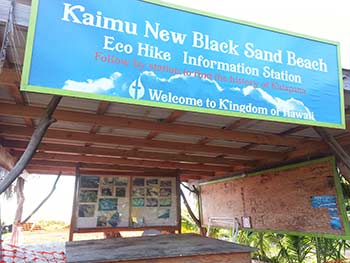
I had hoped that during my stay in Hawaii I’d get to meet some indigenous Hawaiians. Turns out the first place I went after dropping off my things at the house was the ‘official’ Kingdom of Hawaii. Though rapidly falling in numbers, the indigenous Hawaiians are, yes, still there and are somewhat organized in a hierarchical family structure. And Kaimu is now home to Uncle Robert’s Club, a group of Hawaiians and volunteer workers claiming the state land as their lawful heritage. Uncle Robert himself just died a few weeks ago, but he was one of the five elders of the Kingdom, a well-loved and well-respected man.
In 1993 Congress passed the ‘Apology Resolution’ formally acknowledging that America’s takeover of Hawaii was not exactly legal. More recently the natives have been pushing for recognition of what they see as their sovereignty. It’s a hot potato for the state government, an awkward standoff. The Hawaiians would love for the issue to blow up into national attention, and to avoid that the Hawaiian state largely leaves them alone. They have license plates, police, a passport stamp, a sizable plantation, and very little money. They never stamped my passport because the stamp went missing.
In this small community, one of Uncle Robert’s sons was a bit of a celebrity around Big Island until his untimely death a few years ago. His vision had been to plant enough food in the lava to feed all of Big Island in the case of emergency. New Kaimu is covered in young coconut trees now, all hand-planted and mostly coming in nicely.
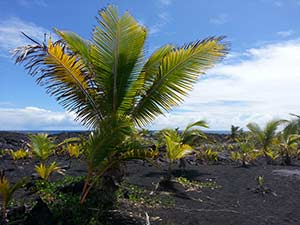
But the bigger project is the breadfruit trees. Breadfruit, or ulu to the Hawaiians, is a large and nutritious green fruit with the consistency and flavor of a potato. Traditional Hawaiian marriages would gift the new couple a breadfruit tree. This symbolizes the couple’s potential to provide for the new family, but it is also practical. A full-grown breadfruit tree is extremely productive and when it gets large it really can feed a family. However, it’s natural reproductive capabilities were bred out long ago, and now they’re difficult to find.
So Uncle Sam’s is planting breadfruit trees all over the fields of raw lava in hopes that they will grow large enough to feed the whole community. It’s an ambitious project, and for the most part few are actually doing the manual labor. The young trees sit in planters waiting for someone to put them in the ground.
Planting in lava is tough. Lava has all the nutrition a plant needs but is too porous to hold water, so you’ve got to find a natural crack, pound it into a hole, and fill it with enough cardboard, dirt and mulch to provide the young tree some water retention. Breadfruit can be finicky, and keeping the trees alive is a big project.
The Hawaiians weren’t really doing the work themselves, nor did they have any money to fund the project. They handed that off to Kenny, one of their agriculture volunteers. With his experience as a bartender, Kenny opened a bar in their club to fund the project, created the procedure for planting and caring for the trees, and led the team of workers. When there was a team.
I hung out at Uncle Sam’s a lot, and when I told Kenny I had some free time to spare he was thrilled. He told me all about the Hawaiians and their quarrels with the government and among each other. Some don’t even want outsiders working for them. But to others, the best thing that you can do for them, the greatest show of solidarity, is to work the land. It is a spiritual practice, in part because the lava itself is sacred to them. “Plant a tree, and you’re like a hero to these people.”
I’m a hero of the Hawaiian people! 🙂